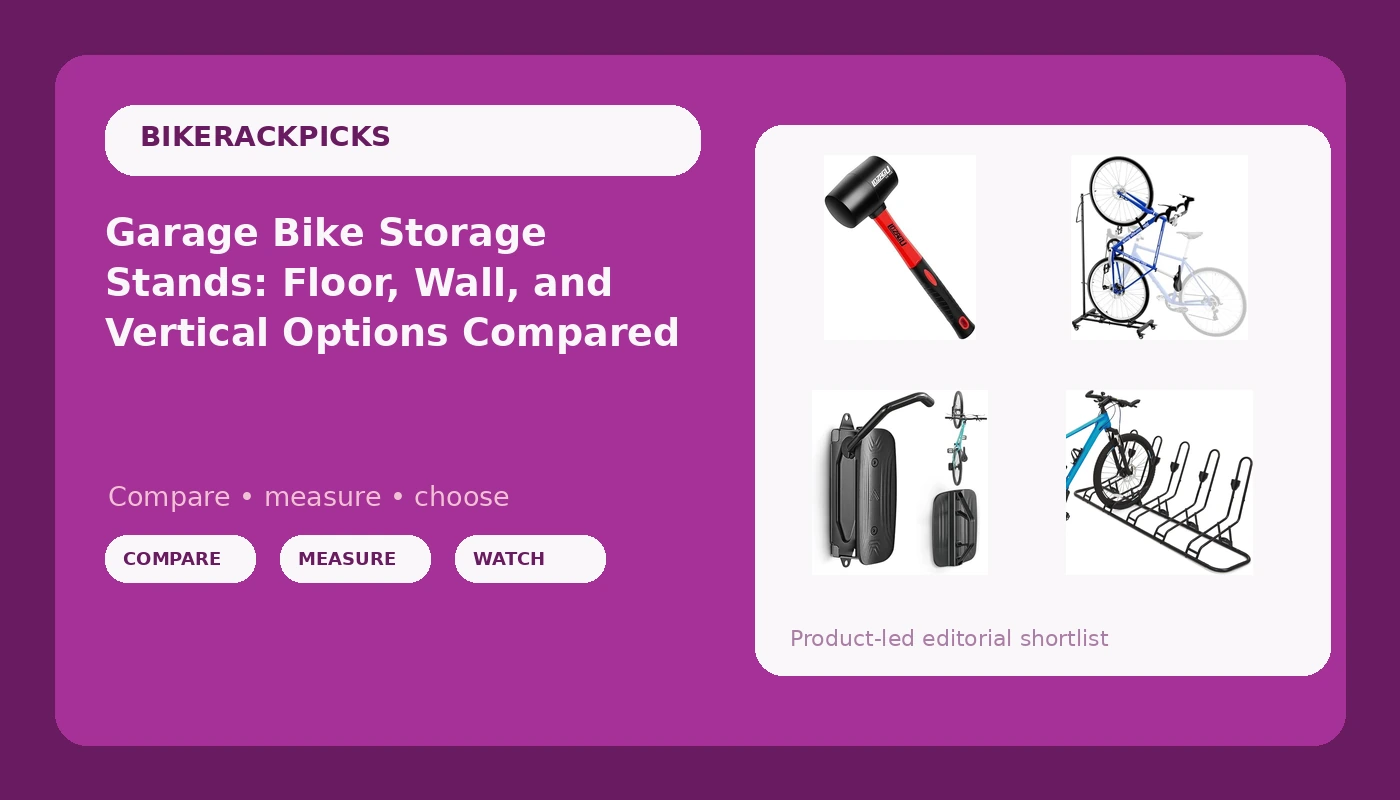
Somewhere in most garages there is a bike leaning against a wall, and a second bike leaning against the first. A garage bike storage stand solves that, but the category is wider than it first appears. A weighted floor stand, a rolling vertical stand, and a folding wall mount all answer the same question in different ways, and each one asks something different of your floor, your walls, and your back. The wrong choice shows up as a stand that creeps across the concrete, a wall mount that pulls out of drywall, or a rack that buries the bike you actually ride every day. This guide covers four pieces of hardware that between them handle the common storage situations, explains what each one is good at, and points out the trade-offs you will live with after the novelty wears off.
Related: Hitch Rack Wobble: Why Your Rack Rattles at 75 mph and What Actually Fixes It →
Quick answer
If you have open floor space and more than two bikes, a multi-bike floor stand is the simplest answer, and the Floor Bike Stand for 5 Bikes is built around keeping disc brakes and derailleurs clear of the stand itself. If you own one bike and floor space is tight, a vertical stand with wheels or a folding wall mount takes up far less room. These are storage products, not transport equipment, so the deciding factors are how many bikes you own, whether you can anchor into a stud, and how often you need to move a bike in or out.
Four useful options
| Model | Best fit | What stands out |
|---|---|---|
| Floor Bike Stand for 5 Bikes, Safeguard Disc Brakes & Derailleurs, Garage | Households with several bikes and open floor space | Freestanding design that holds up to five bikes and is built to keep discs and derailleurs clear |
| Sttoraboks Vertical Bike Stand with Wheels, Indoor Bike Storage Rack | Renters and small rooms with one bike | Stores a single bike upright and rolls on its own wheels |
| monTEK Swivel Bike Wall Mount, Bike Hangers for Garage, 1 Pack | Tight walls and single-bike households | Swivel and fold design lets the bike sit close to the wall when empty |
| 16oz Rubber Mallet Hammer, Fiberglass Handle | Anyone assembling a stand or wall mount | Soft-blow rubber head for seating parts without marring finishes |
Multi-bike floor storage: Floor Bike Stand for 5 Bikes, Safeguard Disc Brakes & Derailleurs, Garage
A floor stand is the least fussy option in this group because it does not depend on your walls at all. You build it, set it on the slab, and start parking bikes. The trade-offs are equally clear. It occupies a permanent patch of floor, it works best on a reasonably level surface, and every bike goes in and out by hand, which means lifting a heavy frame or an e-bike rather than rolling it. For a household with three or four bikes and a garage bay that is not needed for a car, that is a fair deal. The feature worth paying attention to is contact point design, because a stand that presses on a rotor or a rear derailleur is a stand that will eventually cost you a trip to the shop.
Rolling vertical stand: Sttoraboks Vertical Bike Stand with Wheels, Indoor Bike Storage Rack
Vertical storage is the answer when floor area is the scarce resource, not wall area. Standing a bike on its rear wheel turns a footprint roughly the length of a car into something closer to the size of a doorway, which is why this format shows up in apartments and small garages so often. The wheels are the detail that separates a usable vertical stand from a frustrating one, because a loaded stand is heavy and awkward, and dragging it across a floor is how you scratch rims and paint. A stand that rolls can be tucked against a wall during the week and pulled into open space when you need to work on the bike. The usual caveat applies: lifting a bike into a vertical position takes a moment of balance, and it is easier with a lighter frame than with a loaded commuter.
Folding wall mount: monTEK Swivel Bike Wall Mount, Bike Hangers for Garage, 1 Pack
A wall mount gives you back every square foot of floor it touches, which is the whole point. The catch is that it puts the load into your wall, and that means the quality of your anchoring matters more than the quality of the hanger. Into a stud or a proper blocking plate, a single-bike hanger is a straightforward proposition. Into bare drywall with the hardware from a picture frame, it is a bike-shaped hole waiting to happen. The swivel and fold behavior is what makes this style pleasant day to day: the bike swings out toward you for loading, then tucks flat, so the garage wall stays usable for shelves or a workbench. If you are hanging more than one bike, plan the spacing between mounts before you drill, because a folded bike still needs clearance for handlebars and pedals.
Assembly helper: 16oz Rubber Mallet Hammer, Fiberglass Handle, Rubber Mallet for Flooring, Tent Stakes, Woodworking, Camping, Soft Blow Tasks without Damage
This one is not a storage rack, and it belongs in the article anyway. Freestanding stands and wall mounts arrive as tube-and-bracket kits, and the parts that fight you are the ones that need a tap to seat: plastic end caps, press-fit joints, and brackets that are a millimeter shy of lining up. A steel hammer dents those parts, and a rubber mallet does not. A fiberglass handle is a sensible choice for a tool that lives on a garage shelf, since it tolerates being leaned against a wall and forgotten. If you already own a mallet, you own this step. If you do not, it is the cheapest item in this group and the one you will reach for again the next time something needs convincing.
Prices and availability may change. Product images, names, and retailer links are matched to verified listings. No current price, rating, stock status, or measured result is stated here without current evidence.
How much space each design actually needs
The number people get wrong is the length of a bike. Once you count the wheelbase plus the front wheel turned slightly, an adult bike eats more floor than most people expect, and a floor stand that holds five of them is closer to a small motorcycle parking bay than a shelf. Before buying, walk the garage with a tape measure and mark out the stand's footprint with painter's tape, then walk around it. If you cannot stand beside the stand and pull a bike out without stepping over another one, the capacity number is theoretical.
Vertical storage changes the math in a different way. Standing a bike on its rear wheel turns the footprint into roughly the height of the bike plus the width of the bars, and the vertical stand's wheels mean that footprint can move. That flexibility is what makes vertical storage work in rooms that also need to function as rooms. The cost is height: you need clear space above the stand, and a ceiling-mounted garage door track or a low shelf can rule the format out entirely.
Wall mounts consume the least floor of the three, but they consume wall. Bikes hung on a wall are wider than the bike itself once pedals and bars are counted, so leave clearance between mounts and around the edges. Hanging a bike over a workbench looks efficient until you need the bench.
What to check before you buy
Contact points come first. Any rack that touches a disc rotor, a derailleur cage, or a hydraulic brake line is a rack that can turn a storage decision into a repair bill. Look at how the stand or hanger holds the bike and confirm the load lands on a wheel, a tire, or a frame member that is designed for it. Second, decide whether the load goes into the floor or into the wall, and be honest about what your wall actually is. Third, think about the daily motion: how the bike goes in, how it comes out, and whether you can do it one-handed while holding a helmet and a coffee.
- Count the bikes you store indoors, not the bikes you own, and buy for that number.
- Measure the space and tape out the footprint on the floor before ordering anything.
- Identify what is behind the wall where a mount would go, and plan for studs or blocking.
- Check clearance above and beside the position for handlebars, pedals, and a lifted front wheel.
- Walk the loading motion in your head, from garage door to parking position, in the dark.
Practical setup notes for a garage
- Put a floor stand on the most level part of the slab, since a sloped or cracked floor is where creeping starts.
- Anchor wall mounts into studs or solid blocking, and treat drywall anchors as a temporary measure at best.
- Keep rotor and derailleur contact points clear when you set a bike into any stand, every single time.
- Leave a walking lane between the storage zone and the car door, or the stand will end up holding laundry.
- Wipe the stand and the bike down before long-term storage, because garage humidity is what corrodes chains and cables.
Which option should you choose?
Choose the Floor Bike Stand for 5 Bikes, Safeguard Disc Brakes & Derailleurs, Garage when you have several bikes, open floor, and no interest in drilling into anything. Choose the Sttoraboks Vertical Bike Stand with Wheels, Indoor Bike Storage Rack when you have one bike, limited floor area, and you want to move the storage rather than the room around it. Choose the monTEK Swivel Bike Wall Mount, Bike Hangers for Garage, 1 Pack when wall space is available and floor space is not, and you can anchor properly. Choose the 16oz Rubber Mallet Hammer, Fiberglass Handle when you are assembling any of the above and want to seat the parts without chewing them up.
Two limits are worth stating plainly. Nothing here is rated for transport, so this is a storage conversation rather than a hauling one, and hitch-mounted carrying is a separate problem with its own safety rules. And the fit questions, wall construction, floor level, ceiling height, and bike count, are things only you can answer on site. Manufacturer capacity figures describe the product, not your garage.
The bottom line
Storage hardware is cheaper than the damage it prevents, and the decision usually comes down to one question: do you have floor or do you have wall? Floor space and multiple bikes point to the five-bike freestanding stand, which keeps rotors and derailleurs out of the load path. A single bike and tight quarters point to a rolling vertical stand or a folding wall mount, depending on whether you would rather move the rack or use the wall. Whichever you pick, check the contact points, anchor honestly, and keep a rubber mallet within reach for assembly day.